
Seeker Bio
Best Places to See Fall Colours on the Trans Canada Trail

Where Can You See Great Fall Colours on the Trans Canada Trail?
Discover Canada's Hidden Autumn Landscapes from Coast to Coast
Best Places to See Fall Colours on the Trans Canada Trail-Some of Canada's most memorable fall colours can be found along the Trans Canada Trail, from coastal footpaths in Newfoundland and New Brunswick to rail trails, river valleys, prairie coulees and mountain passes farther west.
Having walked the Trans Canada Trail from coast to coast, we've chosen places that combine autumn colour with distinctive landscapes, welcoming communities, and opportunities to explore on foot or by bicycle. These are not your typical fall colour destinations, but rather spectacular spots that lie a little off the beaten path.

Looking Beyond Canada's Familiar Autumn Destinations
Every autumn, familiar names appear on lists of Canada's Best Places to See Fall Colours. Algonquin Provincial Park in Ontario, Cape Breton Highlands National Park in Nova Scotia, Banff and Jasper National Parks in Alberta all deserve their reputations for beauty. However, they represent only a small part of what the season offers across a country whose forests, grasslands, wetlands, mountains and coastal barrens change in remarkably different ways.
During our own hike across Canada, we began to think about autumn differently. A great place to experience fall doesn't have to be a famous lookout crowded with other visitors. It can be a former railway corridor through harvested fields, a city pathway beneath yellowing cottonwoods, a coastal footpath where low shrubs glow against dark stone, or a prairie valley suddenly revealed by a ribbon of gold.
The places below show that fall is not one spectacle repeated across Canada. It is a succession of regional landscapes, each with its own colours, textures, and character. Autumn timing varies greatly by location and from year to year. At higher elevations, conditions can change especially quickly. Before setting out, check current trail conditions, weather forecasts and seasonal operating dates.

East Coast Trail, Newfoundland and Labrador
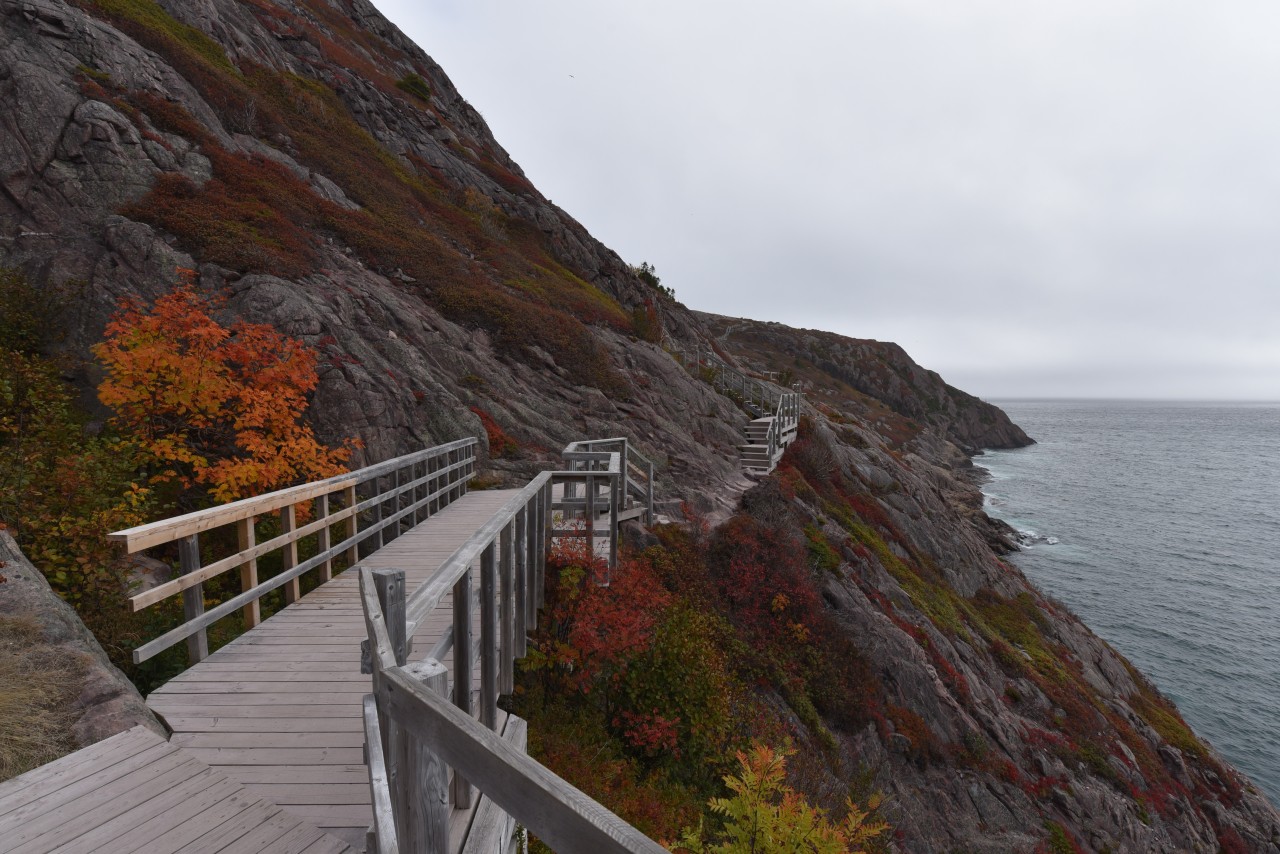
When people picture fall foliage, they often imagine hillsides covered with red and orange maple trees. The East Coast Trail offers another interpretation of the season, giving it a place on our list of the best places to view fall colours on the Trans Canada Trail. Along Newfoundland's Avalon Peninsula, autumn colour can be found close to the ground, where ferns, mosses, lichens, grasses and low coastal shrubs spread shades of red, rust, purple and gold across exposed rock.
The trail extends for approximately 336 kilometres and is divided into 25 wilderness paths linked by community walks. Sections such as Father Troy's Trail, the Cobbler Path, Sugarloaf Path and Deadmans Bay Path lead past sea cliffs, coves, headlands, fishing communities and lighthouses. The Atlantic is rarely far from view, and the contrast between changing vegetation, dark stone, and restless water gives the coast an autumn character very different from the hardwood forests farther west.
We remember the East Coast Trail on Newfoundland's Avalon Peninsula as a place where weather and terrain could alter the mood of a day within minutes. Fog softened the headlands, wind moved unhindered across exposed sections, and ocean views suddenly opened beyond spruce woods and coastal barrens.
The route can be explored one path at a time, but rocky footing, steep terrain and rapidly changing weather demand care. In autumn, carry warm and waterproof layers and remember that shorter daylight leaves less room for delays.

Celtic Shores Coastal Trail, Cape Breton, Nova Scotia
Cape Breton Highlands National Park receives much of the focus of fall travellers to Nova Scotia, but the Celtic Shores Coastal Trail offers an alternative way to experience autumn in Nova Scotia that is no less spectacular.
The 92-kilometre multi-use route follows a former railway bed between Port Hastings and Inverness, connecting communities along a coast shaped by fishing, farming and Celtic culture. Its gentle grade makes it well suited to cycling as well as walking. Forested sections alternate with wetlands, open countryside, glimpses of the Gulf of St. Lawrence and views toward coastal hills. In autumn, mixed woodland adds bands of yellow, orange and red to an already layered landscape.
Voted one of the best hiking trails in Atlantic Canada, in our opinion, the real strength of the Celtic Shores Coastal Trail is the way it connects nature and community. In particular, Judique, Mabou, and Inverness offer opportunities to incorporate food, lively Celtic music, long sandy beaches, and local accommodations into a memorable journey. For autumn visitors, the busiest weeks of summer have passed, the air is cooler, and the trail often feels more spacious. Check seasonal hours for accommodations and other services, particularly later in October.

Confederation Trail, Prince Edward Island
Prince Edward Island may be Canada's smallest province, but its autumn landscapes seldom feel small. The Confederation Trail follows the island's former railway system through forests, wetlands, farmland and charming rural communities. Its main route runs 273 kilometres from Tignish to Elmira, with branch trails bringing the complete network to approximately 449 kilometres. It is easily one of the Best Places to See Fall Colours on the Trans Canada Trail.
This is one of the most approachable long-distance sections of the Trans Canada Trail, and a fantastic place to explore Canada in fall. The former rail bed provides a gentle grade and many opportunities to enter or leave the route. In autumn, yellow poplars and birches and the reds of maples rise beside harvested fields, dark evergreens and the province's famous red soil. Wetlands and slow-moving rivers reflect the changing canopy, while villages and farmsteads keep the journey connected to island life.
When we crossed Prince Edward Island, the quality of the trail and the generosity found in communities along it made a lasting impression that continues to call us back. Food, accommodations and places to rest can be incorporated into a trip, although services become less frequent outside larger communities and some seasonal businesses close after summer.

Fundy Footpath, New Brunswick
The Fundy Footpath is not simply a pleasant walk beneath colourful leaves. It is one of the more physically demanding hiking sections of the Trans Canada Trail, crossing steep ravines and river valleys along New Brunswick's Bay of Fundy coast.
The route is approximately 63 kilometres, and a complete traverse generally requires several days, careful planning and appropriate backcountry experience. In our opinion, the difficulty of the Fundy Footpath is part of what makes the landscape so immersive. The path repeatedly descends toward brooks and coves before climbing through forest. We remember moving from tall spruce dripping with pale green moss into alder stands and then unexpectedly entering hardwoods filled with yellow leaves.
In fall, hardwood colour is set against conifers, moss-covered ground and glimpses of the Bay of Fundy. Alma and St. Martins provide appealing bases for exploring the coastal region, while the Fundy Trail Parkway offers road access and overlooks for visitors who don't want to attempt the entire footpath.
Shorter days, wet leaves, slippery roots, steep descents, river crossings and changing coastal weather can make an already challenging route more difficult. For many visitors, a day hike in Fundy National Park or from an established access point provides an easier introduction to the region's autumn landscape.


Sentier des Caps de Charlevoix, Quebec
The Charlevoix region of Quebec brings together mountains, forest and the broad waters of the St. Lawrence in a landscape that seems designed for autumn. The Sentier des Caps de Charlevoix follows the high country above the river, where lookouts reveal wooded slopes descending toward water that can appear almost oceanic in scale.
The journey is as much about the forest as the views. During fall, yellow birches, red maples and dark conifers create depth across the hills, while rocky paths lead toward a series of impressive panoramas. The Sentier des Caps de Charlevoix trail offers both day-hiking and multi-day possibilities, with rustic cabins and campsites for longer trips.
Reservations, access arrangements and seasonal operations should be checked in advance. Charlevoix is well known but experiencing it on foot changes the scale of the encounter. Rather than viewing the hills from a highway overlook, walkers move through the individual stands of trees that create the distant sweep of colour.


Niagara River Recreation Trail and Niagara Parkway, Ontario
Niagara Falls may be the region's most famous attraction, but the Trans Canada Trail reveals that the Niagara region is much more than a single destination.
The Niagara River Recreation Trail follows the parkway corridor between Fort Erie and Niagara-on-the-Lake, linking natural areas, historic sites, communities and changing perspectives on the river. In autumn, mature trees and river views combine with the cultivated landscapes of the Niagara Peninsula. Around Queenston Heights and Niagara-on-the-Lake, colour spreads through parkland, ravines, orchards and vineyard edges.
Easily accessible from the Greater Toronto Area and Hamilton, this section works well for travellers who want flexibility. A short walk can be combined with a historic site or riverside picnic, while cyclists can cover a much larger portion of the corridor.
The experience is not uninterrupted wilderness. Roads, tourism infrastructure and communities are constant companions. That accessibility, however, makes it possible to enjoy a substantial autumn outing without committing to a remote backcountry trail.

Hamilton–Brantford and Paris Rail Trails, Ontario
West of Hamilton, former railway corridors carry the Trans Canada Trail through the forests and agricultural landscapes of southern Ontario.
The Hamilton–Brantford Rail Trail and routes through Brantford and toward Paris generally have broad, gentle surfaces bordered by mature woodland, wetlands, fields and river valleys. In fall, some sections become tunnels of yellow and orange.
The Dundas Valley adds wooded ravines and rolling terrain near Hamilton, while the Grand River gives Brantford and Paris their own visual centre. Hamilton's waterfalls provide another reason to explore the area, while Paris brings together the Grand and Nith rivers beneath steep, tree-covered banks.
These routes work well for day walks and cycling trips, with nearby communities making it relatively easy to find food and accommodations. Check surface conditions after heavy rain and be aware of road crossings through urban areas.


Whiteshell Provincial Park and Pinawa, Manitoba
In eastern Manitoba, Whiteshell Provincial Park continues the Canadian Shield landscape of exposed granite, clear lakes, boreal forest, wetlands and rushing water. Autumn brings gold to its aspens and birches, while dark spruce, rock and blue water give those colours definition.
The Trans Canada Trail passes through a region of Manitoba that can be explored in very different ways. Experienced hikers may be drawn to backcountry trails, while shorter fall hikes around Pinawa provide accessible opportunities to walk beside the Winnipeg River. The Pinawa suspension bridge and remains of the old Pinawa Dam are particularly strong photography locations, where moving water and weathered structures can be framed by changing leaves.
Our memories of Whiteshell include beautiful lakes and forest, but also terrain that could become wet, rough and difficult. Trail conditions vary considerably, and some sections demand more time and effort than their length suggests. Visitors should check current closures, campground dates and trail reports and prepare for limited services and changing weather.

Qu'Appelle Valley, Saskatchewan
Autumn on the Prairies is not limited to trees. It appears in harvested fields, tawny grasslands, long shadows, clear skies and wetlands filled with migrating birds.
In Saskatchewan's Qu'Appelle Valley, these elements gather around a chain of lakes and steep-sided hills, creating a landscape that can surprise travellers who imagine the province as uniformly flat.
The Trans Canada Trail enters a valley shaped by water, glacial history, agriculture and generations of human presence. Groves of aspen and cottonwood turn yellow along shorelines and coulees, while surrounding fields shift toward gold and brown.
Walking through Saskatchewan's Qu'Appelle Valley taught us how much a landscape can reveal when it isn't hurried past. The Qu'Appelle is well suited to that slower attention. A scenic drive can link trail access points and communities, while short walks or rides allow visitors to enjoy the birds, vegetation and changing light.
Autumn winds can be strong and temperatures can change sharply. Hunting seasons may also overlap with fall recreation in rural areas, so visible clothing and current local access information are sensible precautions.


Calgary Bow River Pathway and Glenbow Ranch, Alberta
The Bow River provides another urban and regional expression of autumn in Alberta. Calgary's pathway system follows the river through parks and neighbourhoods, while the Trans Canada Trail continues west toward Cochrane and Glenbow Ranch Provincial Park.
At Glenbow Ranch, grassy hills rise above the river and railway, with the mountains visible to the west on clear days. We remember the improbable turquoise of the Bow River, silvery wolf willow, stands of trembling aspen and dark spruce on the opposite slopes from our scenic hike through the park.
In autumn, those layers become even more pronounced as aspens turn yellow and grasslands fade to gold.
The exposed terrain can be windy, and weather moving out of the Rockies can change quickly. Carry layers and water even on a short outing, and check current pathway information for closures or detours.


Peter Lougheed Provincial Park and the Elk Valley Trail
For travellers seeking a mountain experience beyond the better-known destinations of Banff and Jasper, the Trans Canada Trail offers opportunities to explore Kananaskis Country in Alberta and the Elk Valley in British Columbia.
The route travels through Peter Lougheed Provincial Park, crosses the Continental Divide at the Alberta–British Columbia border and continues along the Elk Valley Trail toward Elkford. The scale of the landscape changes everything. Forested valleys lie beneath ridges and peaks, while rivers, creeks and wetlands reflect the surrounding slopes. Autumn may bring yellow aspens and cottonwoods at lower elevations and, in suitable alpine areas, the brief gold of subalpine larches.
Our passage through this region was defined not only by its beauty but by the seriousness of travelling through mountain country. Distances between services are substantial, weather can change without warning, wildlife precautions are essential and early snow is possible even while lower valleys remain in autumn.
Some portions can be explored on shorter outings from established access points, but a longer journey toward Elkford requires preparation, navigation, backcountry equipment and current information. For those ready for those conditions, it offers a quieter view of the Rockies and a powerful sense of crossing from one watershed and province into another.


Stanley Park and the Vancouver Seawall, British Columbia
Stanley Park shows that an autumn outing doesn't necessarily mean you need to leave the city behind. Located beside downtown Vancouver, British Columbia, the park combines mature coastal forest, beaches, seawall views and connections to the wider Trans Canada Trail network.
Autumn colour on the coast is often subtler than the hardwood displays of eastern Canada. Nonetheless, bigleaf maples and other deciduous trees contribute yellow and gold beneath towering conifers, while rain darkens trunks, stone and forest soil. Along the seawall, those colours are set against Burrard Inlet, English Bay, the North Shore mountains and the changing light of the Pacific coast. Visitors to Vancouver's Stanley Park can cycle or walk the seawall, explore interior paths, watch birds along the shoreline or combine the park with a longer journey through Vancouver.
Our arrival at the Pacific end of the long east-to-west journey reinforced something the TCT had shown us repeatedly: meaningful encounters with nature are possible within urban centres as well as distant wilderness. Stanley Park is its own expression of the season, where a large city meets coastal forest and ocean.

Why Explore the Trans Canada Trail in Autumn?
Fall brings cooler walking temperatures, fewer mosquitoes and, after the summer holidays, more space on many trails. It is also a season of movement. Migrating birds gather along coasts, wetlands and river valleys, animals prepare for winter, and familiar landscapes can change almost daily.
The trade-offs are shorter days, colder mornings and potentially slippery or hidden trail hazards. Seasonal services may also be reduced, while mountain and northern regions can experience winter conditions surprisingly early.
The Trans Canada Trail lets you experience the season at many levels. You might cycle across Prince Edward Island, backpack the Fundy coast, spend an afternoon in Edmonton's river valley or follow Vancouver's seawall beneath yellowing maples. The right destination depends on your experience, available time and preferred way of connecting with the landscape.

Frequently Asked Questions About Fall Colours on the TCT
When is the best time to see fall colours in Canada?
Timing depends on latitude, elevation, weather and tree species. Colour may begin in northern or high-elevation areas in early September, while some southern and coastal locations remain colourful into October.
Because conditions change each year, check provincial fall-colour reports, local tourism organizations and trail operators shortly before travelling.
Can these Trans Canada Trail sections be explored as day trips?
Yes. Stanley Park, Edmonton's river valley, Calgary's Bow River pathways, Pinawa, the Niagara corridor and many sections of the Confederation and Celtic Shores trails work well for short outings. The Fundy Footpath and longer mountain routes require substantially more preparation, although nearby parks and access points offer day-hiking alternatives.
Are these routes suitable for cycling?
Many are, but not all. Former rail trails such as Celtic Shores, the Confederation Trail and the Hamilton–Brantford–Paris corridor are particularly appealing for cycling. Urban pathways in Edmonton, Calgary and Vancouver also provide strong options. Rugged wilderness footpaths such as the East Coast Trail and Fundy Footpath are intended for hikers rather than cyclists.
What should I bring for an autumn trail outing?
Carry layered clothing, rain protection, water, food, navigation and a light or headlamp. Footwear should suit wet leaves, mud, rocks and roots. On remote routes, add emergency equipment, wildlife protection appropriate to the region, and the supplies required for self-sufficient travel.
Are trail facilities and accommodations open throughout the fall?
Not always. Campgrounds, visitor centres, restaurants, shuttles and seasonal accommodations may reduce their hours or close after summer. Check directly with parks, trail organizations and businesses before building an itinerary, particularly in Atlantic Canada, rural areas and mountain regions.
Where can I check current Trans Canada Trail conditions?
Begin with the official Trans Canada Trail map and trip-planning information, then consult the provincial park, municipality or local trail organization responsible for your chosen section. Local sources are essential because construction, storms, wildfire, flooding, hunting seasons and early snow can alter access with little warning.

Discover Canada's Fall Colours Along the Trans Canada Trail
From the rugged Atlantic coastline to the forests, prairie valleys and Rocky Mountain landscapes of the west, the Trans Canada Trail offers countless ways to experience Canada's fall colours beyond the usual destinations. Whether you choose a gentle rail trail, a riverside cycling route or a challenging wilderness hike, autumn is an invitation to explore more slowly and see the country from a different perspective. Wherever you travel, plan ahead, check trail conditions and leave yourself time to appreciate the remarkable landscapes that make this coast-to-coast trail so special.
Best Fall Colours on the Trans Canada Trail
Discover Canada's best fall colours along the Trans Canada Trail.
When you subscribe to the blog, we will send you an e-mail when there are new updates on the site so you wouldn't miss them.
About the author










Comments 1
Really beautiful colours. Sean must of been in his hay day.